
-
 By Derek Duckworth
- December 11, 2025
- 0 Comments
- Blog
Do Chat Rooms Make Us More Honest or Just More Lonely?
"We expect more from technology and less from each other." It is 2:00 AM. The house is silent, but the screen is loud. In a dimly lit room, a person types a confession into a forum they have never visited before, sharing a fear they haven't told their spouse of twenty years.
- Anonymous confessions
- Deep, honest chats
- Find real connection
What Chat Rooms Promise: Freedom, Anonymity, and Connection
Chat rooms offer something uniquely appealing: open dialogue without judgment. When I enter a chat room, I can choose my identity, control how much I reveal, and disconnect whenever I want. This digital freedom creates a psychological safety net that many people find liberating.
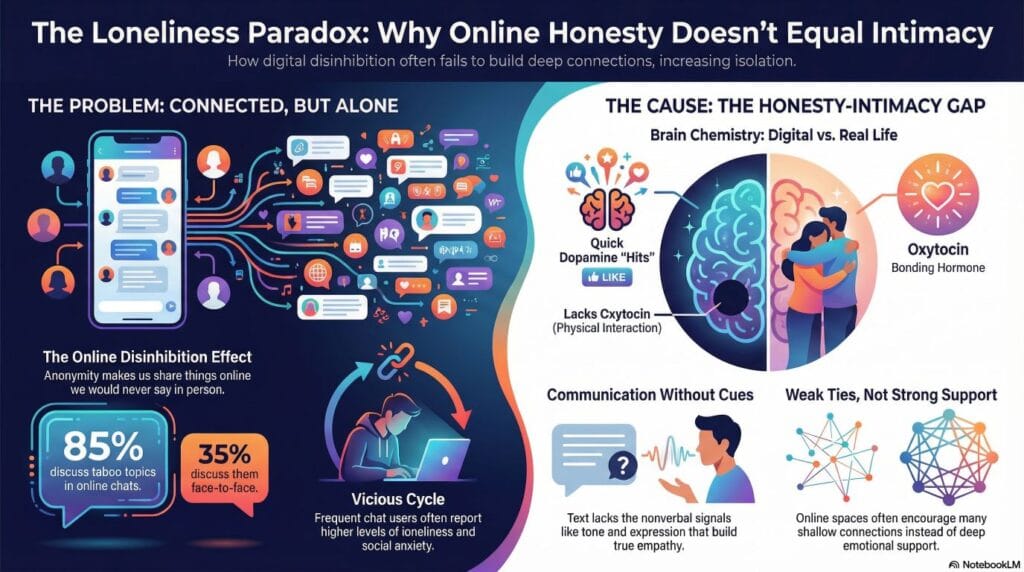
The appeal makes perfect sense when viewed through the lens of what psychologists call the Online Disinhibition Effect. First described by John Suler in 2004, this phenomenon explains why people feel comfortable sharing things online that they might never say face-to-face. Without seeing others' immediate reactions or worrying about social consequences, our self-censorship mechanisms relax. Researchers studying the psychology of chat rooms and online social interaction have repeatedly observed how anonymity changes the way people communicate.
Many users report experiencing profound relief when discussing stigmatized topics in chat rooms. Health concerns, sexuality questions, and relationship struggles find voice in these anonymous spaces. But openness isn't the same as connection – and data shows it can have a hidden cost. In some cases, the constant pull of digital conversation can even develop into patterns similar to chat room addiction, where online interaction begins to replace meaningful offline relationships.
Likelihood to Discuss Taboo Topics
Source: Whitty (2002) - 320 Respondents
Short-Term Gain, Long-Term Gap
Peter, Valkenburg, and Schouten's 2005 study took this research further. They discovered that while online self-disclosure does increase feelings of closeness temporarily, it rarely translates to lasting intimacy. The initial rush of connection often fades without the reinforcement of shared physical experiences and nonverbal communication.
The Loneliness Paradox
Perhaps most telling is Morahan-Martin and Schumacher's 2003 research, which found that frequent chat users reported significantly higher levels of loneliness and social anxiety than occasional users. This suggests that many people turn to chat rooms as compensatory behavior – using digital spaces to fill gaps in their offline social lives.
Caplan's 2007 study introduced the Preference for Online Social Interaction (POSI) scale. His research consistently showed that those with higher POSI scores typically had poorer offline social support networks. Across decades of studies, a consistent pattern emerges: chat rooms promote openness, yet for some users they can also amplify feelings of isolation.
Why This Happens: The Honesty-Intimacy Gap
The reasons behind this gap aren’t singular; they play out on several levels at once: psychological, cognitive, and social.
The Neuroscience of Connection
Dopamine
The Digital "Hit"When I receive fast replies in a chat room, my brain experiences a dopamine loop—the same reward system activated by likes. It creates an illusion of closeness that feels satisfying but lacks depth.
Oxytocin
The "Bonding Hormone"Physical interaction triggers oxytocin. Our mirror-neuron systems activate when we see expressions, helping us literally "feel what they feel." Digital communication simply doesn't trigger this biological mechanism.
The Psychology Behind It
First, the reduced social risk of anonymous interaction makes honesty easier. But this same anonymity removes many of the cues that build true empathy. Without seeing facial expressions, hearing tone of voice, or sharing physical space, our brains process these interactions differently. The subtle nonverbal cues that signal understanding are missing, leaving even honest exchanges feeling somehow incomplete.
The Cognitive Mechanism
As Nicholas Carr noted in his 2010 book "The Shallows", reading and writing online tends to fragment our attention. We scan rather than absorb. This cognitive style trains us for quick emotional expression but not deeper emotional processing. We become adept at sharing our thoughts but less practiced at the sustained attention that builds genuine understanding.
The Social Mechanism
Chat rooms often prioritize breadth over depth. This structure encourages what sociologists call "weak ties" – connections that provide information but not deep emotional support. I might feel better after venting, but without the follow-through of sustained relationship building, that temporary relief doesn't translate to lasting connection.
From 2000s Chat Rooms to 2025 AI
Separation between 'online' and 'real' life. Anonymity was default. Interfaces like Yahoo! Chat prevailed.
Smartphones dissolved boundaries. Increased self-disclosure alongside potential isolation persisted in Discord and WhatsApp.
Replika, Woebot, and AI companions offer 24/7 availability. They promise openness without judgment, raising the question: Are we simply automating loneliness?
Recent studies in Frontiers in Psychology (2024) on AI companionship suggest that people often form emotional attachments to these digital entities. The research shows that AI companions can reduce subjective feelings of loneliness while potentially decreasing motivation to seek human connection – a concerning trade-off.
What Could Change: Building Real Connection
Design Solutions
Digital spaces could evolve to better support genuine connection. Encouraging continuity of identity through persistent usernames helps build trust. Some platforms have begun integrating structured emotional check-ins. These design choices acknowledge that meaningful connection requires more than just the ability to speak freely.
Personal Strategies
As individuals, we can approach online communication more intentionally. I've found that using online openness as a gateway to deeper relationships works well – starting with chat, moving to video calls, and eventually meeting in person.
Educational & Cultural Interventions
Teaching "digital empathy" skills in schools could help prepare young people. We must recognize that online and offline interactions offer different benefits rather than seeing one as inferior.
Truth Without Touch: The Ongoing Paradox
Chat rooms increase honesty, but not intimacy. They give us the freedom to speak – not necessarily the feeling of being heard. The problem isn't that we're lying less – it's that we're connecting less deeply.
As I reflect on my own experiences in digital spaces, I find myself wondering: Are we really sharing ourselves – or just broadcasting loneliness? The answer likely lies somewhere in between.
Academic Research & Books
- Whitty, M. (2002). Liar, liar! An examination of how open, supportive and honest people are in chat rooms.
- Suler, J. (2004). The Online Disinhibition Effect.
- Caplan, S. (2007). Relations among loneliness, social anxiety, and problematic Internet use.
- Carr, N. (2010). The Shallows: What the Internet Is Doing to Our Brains.
- Turkle, S. (2011). Alone Together: Why We Expect More from Technology and Less from Each Other.
Frequently Asked Questions
Do chat rooms cause loneliness or do lonely people just use them more?
Research suggests it's a bidirectional relationship. Studies like Caplan's (2007) show that people who are already experiencing some loneliness may turn to chat rooms for connection. However, exclusive reliance on chat rooms without developing offline relationships can potentially increase loneliness over time.
Are there specific types of chat rooms that promote better connection?
Smaller, interest-based chat communities with consistent membership tend to foster deeper connections than large, anonymous chat rooms. Video-enabled chat can also help bridge the gap between text-only communication and in-person interaction.
How can I tell if my chat room use is healthy?
Consider whether your online interactions are complementing your offline relationships or replacing them. If you find yourself avoiding in-person social opportunities in favor of online interaction, it might be worth reassessing.
