
-
 By Derek Duckworth
- February 16, 2026
- 0 Comments
- Chat Room News
UK Online Safety Act:
Age Verification & Privacy
Join the conversation on how the new UK laws affect small websites, chat rooms, and user privacy. Discuss ID checks, facial estimation, and what it means for the future of the internet.
The UK Online Safety Act has created a significant challenge for small website owners, particularly those running chat rooms or forums. New requirements mandate “highly effective” age verification systems to prevent minors from accessing potentially harmful content. For small site operators with limited resources, these verification requirements represent not just a technical hurdle but a potentially existential financial threat. This guide breaks down the available verification options, their real costs, and the broader impacts on your online community.
Understanding the UK Online Safety Act Requirements
The Online Safety Act requires websites with UK users to implement age verification or age assurance measures if they host user-generated content that could be harmful to children. For chat rooms and forums, this means verifying users are adults before allowing access to unmoderated conversations. Simple self-declaration checkboxes (“Are you over 18?”) are explicitly deemed non-compliant by Ofcom, the UK’s communications regulator.
Sites must implement what Ofcom calls “highly effective age assurance” – technical solutions that can accurately determine whether a user is a child or an adult. The law applies to any site with UK users, regardless of where the site is hosted, putting the burden on operators worldwide to comply or potentially face penalties.
The requirements create a particular challenge for small websites that lack the resources of major platforms but still fall under the same regulatory framework. While the goal of protecting children is universally supported, the implementation costs fall disproportionately on independent online communities.
Available Age Verification Methods and Their Costs
Small website owners have several options for implementing age verification, each with different costs, privacy implications, and user experience impacts. Here’s a breakdown of the main approaches:
Photo ID Verification
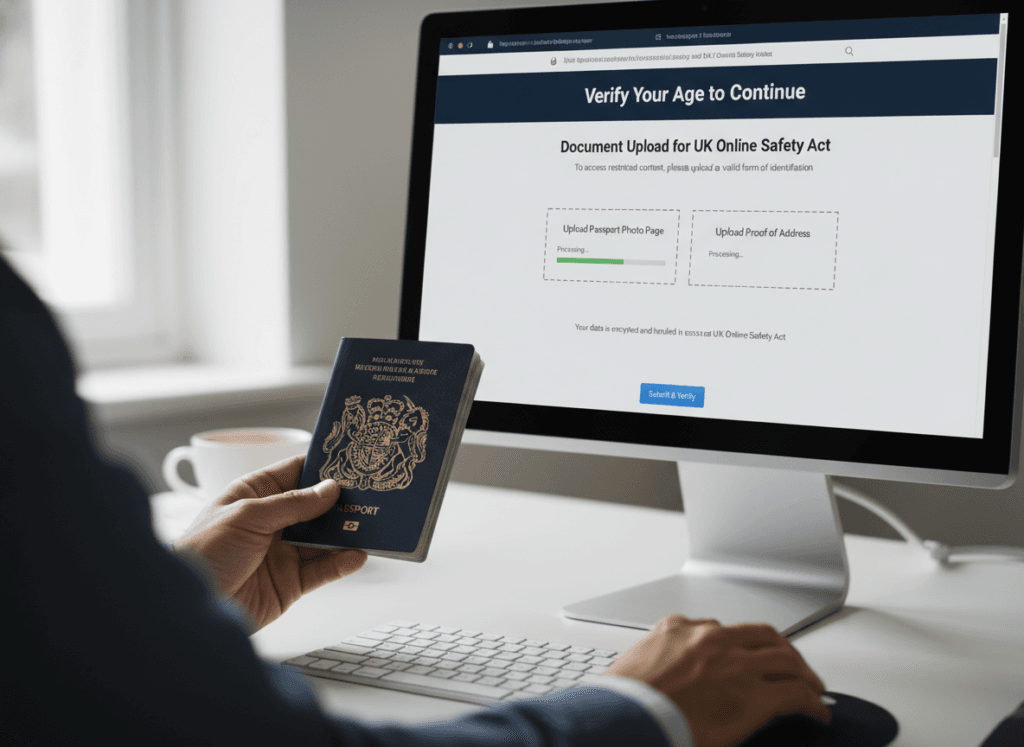
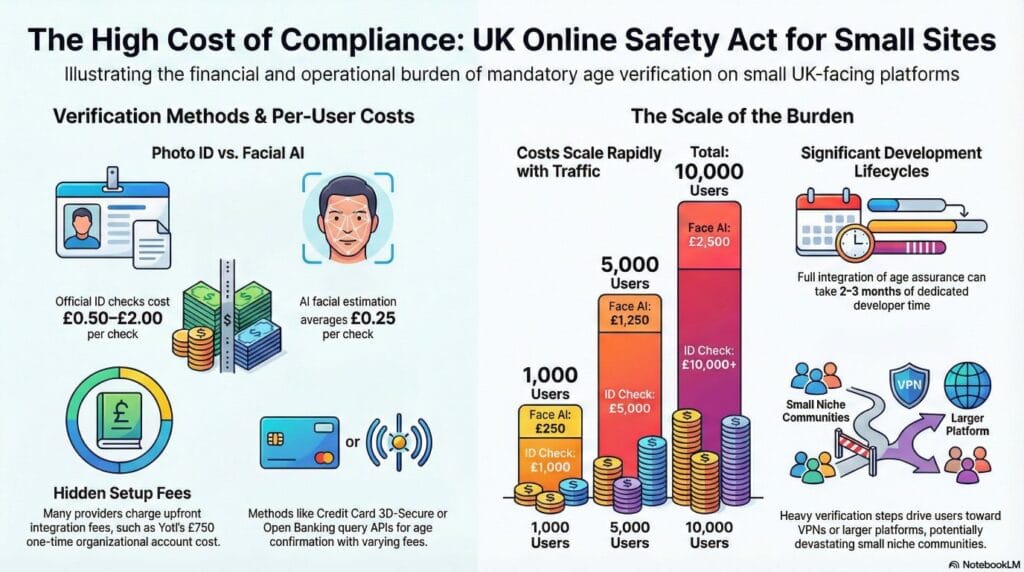
This method requires users to upload a government-issued ID (passport, driver’s license) which a third-party service verifies for authenticity and extracts the date of birth. It provides high assurance but introduces significant friction in the user experience.
Cost: Typically £0.50–£1.00 per verification on a pay-per-check basis. Yoti’s pricing via the UK Government G-Cloud lists £1.00 per age check when scanning an ID document. Services like Veriff or Onfido charge approximately £0.65–£1.60 per verification with monthly minimum fees. Many providers also require upfront setup costs – Yoti charges a £750 integration fee for an organizational account.
Implementation: Requires integrating an SDK or API to capture the document and possibly a selfie for face matching. While technically complex, many providers offer no-code or low-code widgets to simplify integration.
Privacy Considerations: The site can typically avoid storing the ID itself – the third-party handles verification and returns only an age confirmation. However, sensitive personal data is processed, raising GDPR considerations.
Facial Age Estimation

Users show their face via camera (photo or video), and an AI model estimates whether they are over the required age threshold. This method is fully automated and doesn’t require storing personal identity information, making it relatively privacy-preserving.
Cost: Typically cheaper than full ID verification at approximately £0.25 per transaction with Yoti’s facial age-estimation API (with volume discounts beyond 10,000/month). Other vendors with similar technology (like Clearview’s Age Estimate) are in the same price range. Persona even offers a free tier of 500 face/ID verifications per month, though beyond that it costs about £1.20 per verification.
Implementation: Requires integrating a face-scan SDK or redirect. From a development perspective, this is moderately complex, but many platforms have adopted such solutions because they are relatively streamlined.
Privacy Considerations: There’s ongoing debate whether this constitutes processing of biometric data under GDPR. Providers argue if it’s just estimating age and not uniquely identifying the person, it may not trigger GDPR’s biometric provisions.
erification Method | Estimated Cost per Check | Implementation Complexity | Privacy Level | User Friction | Limitations | Suitability for Small Sites (Inferred) | Source |
|---|---|---|---|---|---|---|---|
Email Address “Digital Footprint” Analysis | £0.10–£0.50 | Moderate | High | Low | Probabilistic; fails for brand new or burner emails; requires fallback method. | High (very user-friendly and relatively low cost). | [1] |
Credit Card or Debit Card Checks (3DS) | £0.05–£0.30 | Moderate | Moderate | Moderate/High | Requires credit card (debit cards don’t prove age); users wary of entering card info. | High (lowest per-check cost if payment gateway is already integrated). | [1] |
Facial Age Estimation (AI Face Scan) | ~£0.25 (up to $1.50) | Moderate | High | Moderate | Inaccurate for borderline ages (18–20); may require ID fallback. | Moderate (more affordable and automated, but still involves integration effort). | [1] |
Mobile Network Operator (MNO) Age Check | Not in source | Moderate/High | High | Low | Requires UK postpaid account; excludes family plans, business phones, and most PAYG SIMs. | Moderate (frictionless for users but requires dealing with aggregators). | [1] |
Open Banking (Bank Account Confirmation) | £0.30–£1.00 | Moderate/High | High | High | Requires online banking login; higher friction may cause user drop-off. | Low/Moderate (secure but expensive and high friction). | [1] |
Photo ID Verification | £0.50–£1.00 (0.80–2.00) | High | Moderate | High | Users must provide personal documents; requires official ID (passport/license). | Low (due to high per-check costs, setup fees, and high friction). | [1] |
Digital Identity Wallets (Reusable ID) | ~£0.25 | Moderate | High | Low (for existing users) | Low user uptake; only a fraction of users have these apps set up. | Low (cannot be used as a standalone method due to low adoption). | [1] |
Basic Self-Certification (Age Gate) | Free | Low | High | Very Low | Not compliant with UK Online Safety Act; easily bypassed by children. | None (illegal under new regulations). | [1] |
Credit Card or Debit Card Checks
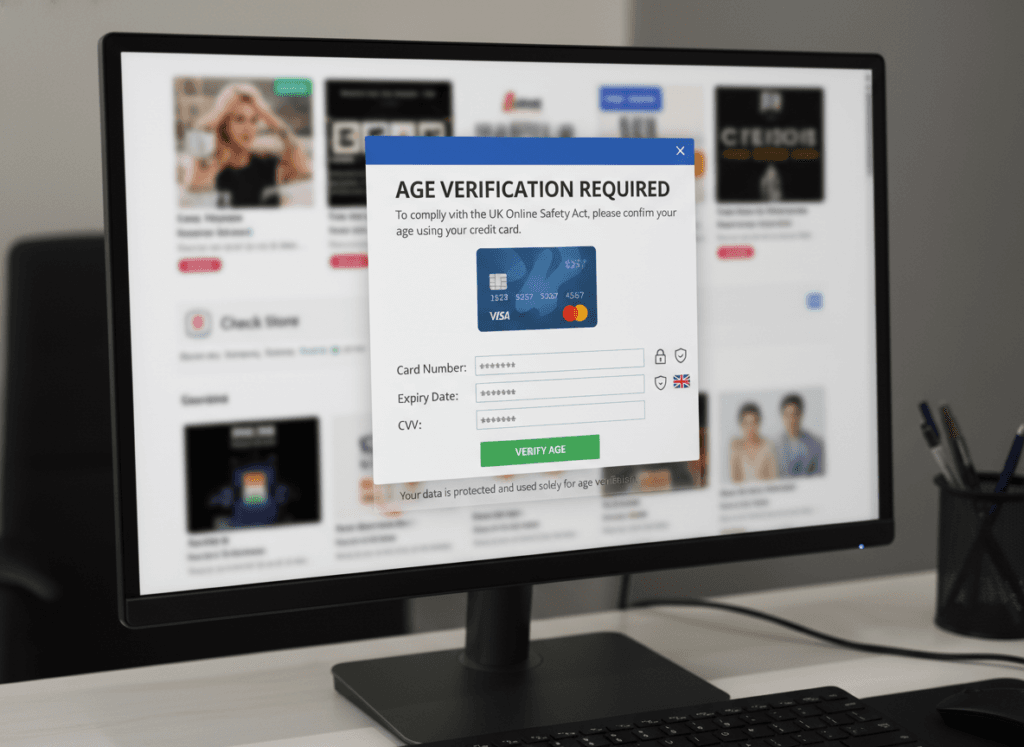
Users provide a credit card (typically via a 3D Secure authentication flow) to prove adulthood. Since UK residents must be 18+ to obtain a credit card, a successful verification implies the user is an adult. Many gaming platforms like Steam now use this method for UK users to unlock mature content.
Cost: This method can be very low-cost per user – often just the payment processor’s fee for a £0 authorisation or a tiny charge. The site can run a £0.01 transaction (immediately voided) or a 3-D Secure check with no charge. Payment processors like Stripe typically charge a few pence for an auth, so the effective cost might be on the order of £0.05–£0.30 each.
Implementation: If your site already has e-commerce functionality, this is straightforward – otherwise, you must integrate a payment gateway. It also requires users to have a credit card (debit cards won’t prove age, since minors can have those).
Privacy Considerations: Financial information is handled by the payment processor; the site should not store card details itself. Users may be more willing to trust an established payment processor than an unknown site with their ID.
Mobile Network Operator (MNO) Age Check
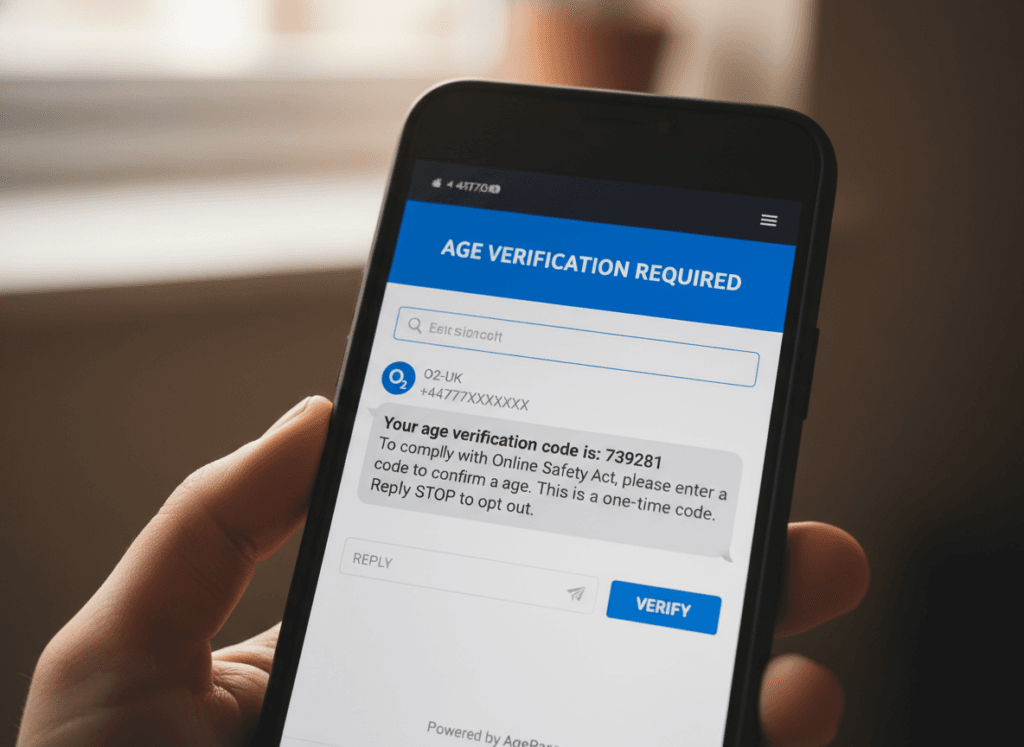
UK mobile carriers maintain “adult content” filters on customers’ accounts – users prove their age to the carrier to remove the 18+ content block on mobile data. With the user’s consent, your site can query an API to ask the mobile operator if that phone number is verified as 18+.
Cost: Pricing for these carrier APIs is not publicly advertised, but likely they will charge per API call. We can infer the cost might be comparable to other verification checks (tens of pence each). For a small site, using this method might require a contract with an aggregator service.
Implementation: The site needs to integrate the API and handle the SMS OTP flow, though some services manage that part. This adds some development overhead but is less intrusive than handling document images.
Limitations: The mobile number must be a UK postpaid account in the user’s name with age info on file. It won’t work for users on family plans, business phones, or many pay-as-you-go SIMs.
Open Banking Age Confirmation
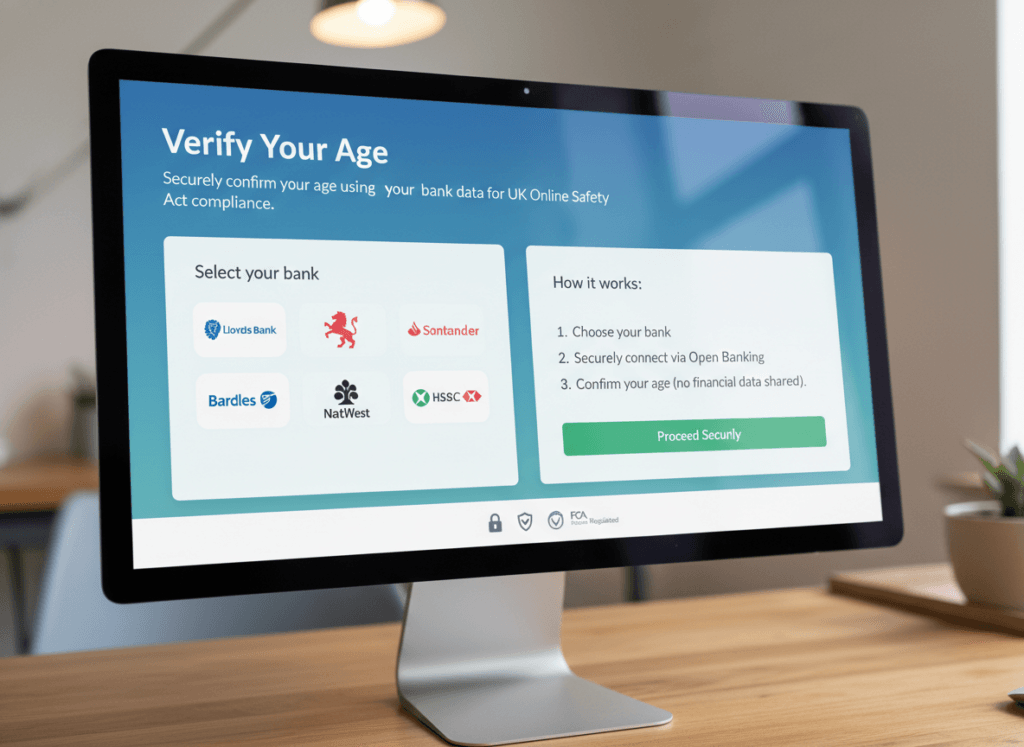
Through the Open Banking framework, a user can consent to share certain info via their bank. An age-check service (like OneID) can query “is this account holder over 18?” and get a yes/no from the bank. The flow typically redirects the user to their online banking login to approve the data request.
Cost: Open Banking API calls often have fees – perhaps on the order of £0.30–£1.00 per query through an intermediary. Because this method leverages high-security infrastructure, it may cost more than a simple ID check.
Implementation: This is more involved for the user – they must have online banking and be willing to log in and authorize data sharing, which could cause drop-off. However, it avoids handing over ID documents to a third party.
Privacy Considerations: The site doesn’t see any financial details, only the confirmation from the bank via the third-party service. Banks are highly trusted with personal data, so from a user perspective this might feel safer.
Digital Identity Wallets
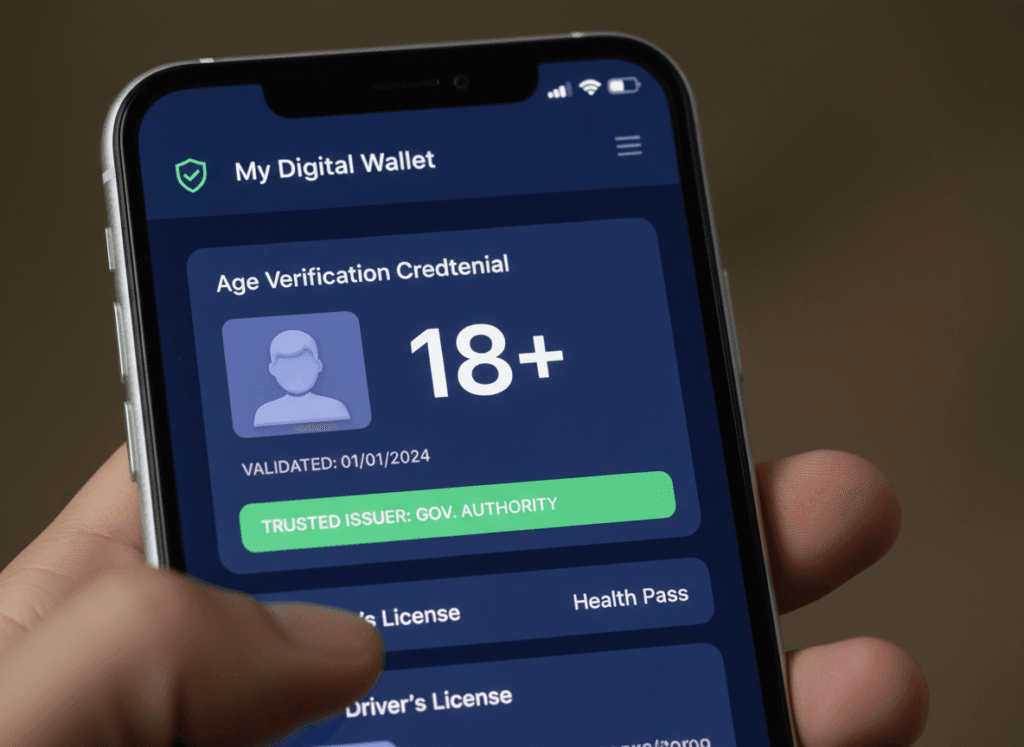
An emerging solution is the use of digital ID apps or wallets that can store verified identity attributes and share an attestation that “user is 18+” without exposing full identity details. Examples include the Yoti app, the UK Post Office EasyID, or features in Apple/Google Wallet.
Cost: If using a third-party digital ID provider like Yoti, the cost to the site is similar to other methods – roughly £0.25 each in their model. Some digital ID solutions might be free during early adoption phases.
Implementation: This method works best if offered alongside others, as only a fraction of users will already have a digital ID app set up. For those users, it can streamline the process (just a QR code scan or button click).
Limitations: Low user uptake is the main drawback – a small site can’t rely on this alone unless its userbase is very tech-savvy.
Email Address "Digital Footprint" Analysis

Services like VerifyMyAge (VMA) have algorithms to check where and how long an email has been used. The user provides an email and clicks a verification link; then the service scans for records indicating the email owner’s age range. Ofcom has endorsed this as potentially “highly effective” when done with reliable data.
Cost: Because this method likely involves querying multiple databases, the cost per check might be moderate – perhaps similar to credit checks or a fraction of full ID verification (estimates put it around £0.10–£0.50 per check).
Implementation: Very user-friendly – almost everyone has an email, and providing it + clicking a link is low friction compared to scanning documents.
Limitations: It’s probabilistic – if an email is brand new or only tied to age-unknown services, the system might not confidently verify age, requiring a fallback method.
Projected Costs for Small Website Operators
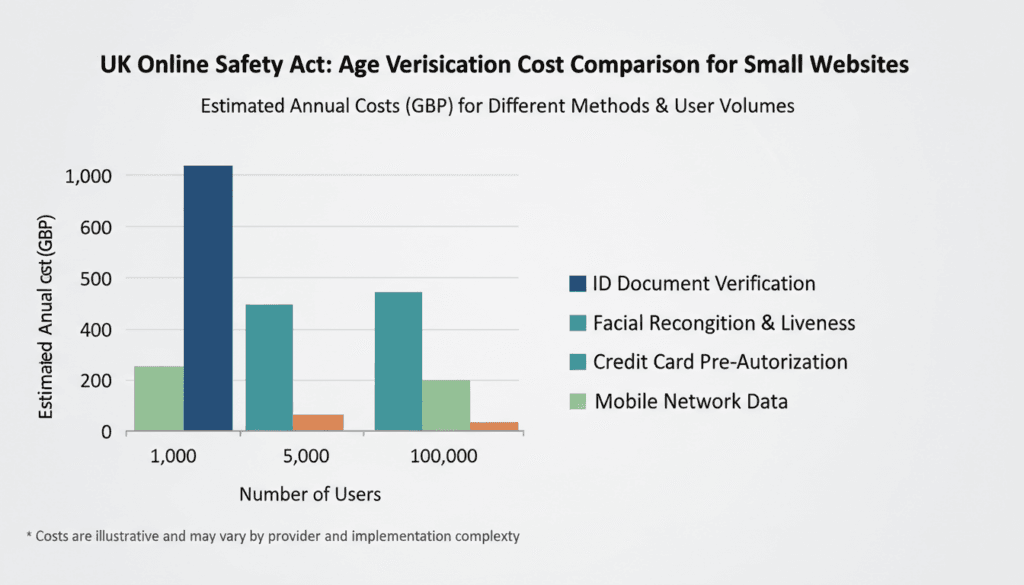
What would these verification solutions actually cost a small UK-focused chat site in monetary terms? Let’s break down a few scenarios based on monthly active user counts:
For Sites with ~1,000 UK Users
If all 1,000 users need one-time verification using facial age estimation (~£0.25 each), that’s about £250 in direct fees. Using ID-based verification at ~£1 each would cost approximately £1,000. Some services have monthly minimums – Veriff’s self-serve plan costs at least £40 per month for up to ~60 verifications, even if you don’t use all of them.
AgeChecker.Net (used by small e-commerce sites) quotes $25/month + $0.50 per verification, which would total approximately £430 for 1,000 checks. So the initial verification of your user base would likely cost a few hundred pounds at minimum.
For Sites with ~5,000 UK Users
At £0.25 each for facial estimation, 5,000 checks would cost approximately £1,250. Some volume discounts might apply, but at this level, they would be minimal. If your site uses a mixed-method approach (70% face scans, 30% ID uploads), the weighted cost might be higher since ID checks cost more.
A reasonable estimate would be £1,000–£2,000 to verify 5,000 users initially. For ongoing operations, if approximately 500 new UK users join monthly, that’s an additional £125 per month at £0.25 per verification.
For Sites with ~10,000 UK Users
Costs would reach about £2,500 at £0.25 per head, or up to £5,000+ if using pricier checks or an aggregator service. A site with this many users might negotiate a custom rate with a provider – perhaps £0.20 per verification, resulting in approximately £2,000 for 10,000 users.
Remember that these costs recur with user churn – as people leave and new ones join, new verification costs continuously accrue. For a site with high turnover, this becomes a significant ongoing expense.
Additional Cost Considerations
Beyond per-verification fees, you must consider setup costs. Many providers charge a one-time integration fee (like Yoti’s £750). If using an aggregator service, there might be monthly subscription fees – one small forum admin reported being quoted £200 monthly for a compliant solution, regardless of verification volume.
Developer time is another major expense, often overlooked. According to one company, implementing age assurance took “2–3 months of 4–5 developers’ time” for integration and testing. A small site with a single part-time developer can’t devote that level of resources. Using ready-made SDKs can help, but you’ll still need to integrate the age-gate flow, connect verification tokens to your login system, and handle users who fail checks.
A savvy developer might implement a simple verification option in a week or two. If you need to hire help, the one-time cost could reach thousands of pounds (e.g., 80 hours at £50/hour = £4,000).
Small Sites Can’t Afford Compliance But Nobody Knows If It’s Even Required
If you just read those numbers and felt sick, you’re not alone.
You can’t afford this. A forum running on donations can’t find £2,500. A hobby chat site can’t pay £125/month forever. You don’t have £4,000 for a developer. This isn’t possible for you.
Here’s the thing: nobody else is doing it either. Not Discord. Not the random chat sites. Not anyone. The big platforms are ignoring this and waiting to see what happens.
So you’re stuck. You can’t afford to comply. But you also don’t know if you’ll get fucked for not complying. There’s no enforcement yet, but that could change tomorrow. You could be fine, or you could be the example they make.
The law doesn’t care that you’re small. It doesn’t care that you make no money. It treats you exactly like Facebook, except Facebook can afford lawyers and you can’t.
You’re not fucked yet, but you might be. And there’s no good answer.
Beyond Direct Costs: Other Impacts on Small Websites
Data Protection and Privacy Compliance
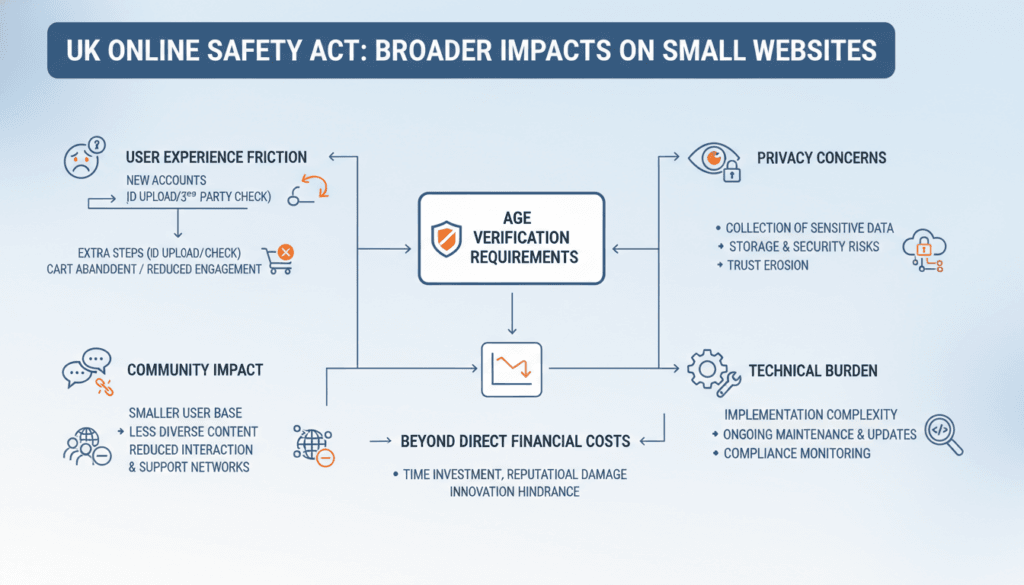
By implementing age verification, your site is potentially handling sensitive personal data, even if indirectly. You must carefully choose providers that minimize data exposure and ensure your site only stores a yes/no “verified” status rather than actual identity data.
Your privacy policy will need updating to explain this processing. The Information Commissioner’s Office (ICO) expects organizations to perform a Data Protection Impact Assessment (DPIA) when deploying age assurance, particularly if biometric data is involved. Obtaining explicit user consent for processing is essential for GDPR compliance.
Working with established age-check providers mitigates some risk, but the legal responsibility still ultimately lies with your site to ensure user data is handled properly. This adds an administrative burden that small sites with no legal team will find daunting.
User Experience and Conversion Loss
Perhaps the biggest “cost” is the impact on user acquisition and community participation. Any age verification introduces friction – additional steps before a new user can join or an existing user can continue. Many users will simply leave rather than complete the process.
The UK’s porn site age checks led to a huge surge in VPN usage – top free VPN apps saw downloads spike by 1,800% as users tried to bypass restrictions. That implies many users would rather use technical workarounds than hand over personal data.
For a small chat forum that thrives on having a critical mass of active users, this drop-off could be devastating. If signing up is no longer a quick username/email process, but now requires passport photos or a selfie scan, a large percentage of potential users will abandon the process.
Loss of Anonymity and User Trust
Many small chat sites are valued for the pseudonymity or anonymity they offer. Requiring age verification can conflict with that ethos. Even if your site isn’t directly collecting IDs, users may perceive that their anonymity is compromised.
Mental health support forums or LGBTQ+ communities might have users who are very hesitant to reveal any identifying information. Forcing them through an age-check could deter those who fear outing themselves or who simply don’t trust third parties.
Some users may not have the “acceptable” credentials – an 18-year-old without a passport or driver’s license would struggle with ID-based verification, while someone without a credit card can’t use that method. These legitimate adult users might be excluded due to the verification barrier.
Real-World Impact on Small Communities
We’ve already seen some small UK-based forums choose to shut down or block UK users rather than implement age checks. The owner of the LFGSS cycling forum announced its closure because “the act is too broad… I can’t afford what is likely tens of thousands [of pounds] to go through all the legal hoops here… the site… cannot afford compliance costs”.
Another niche forum’s admin revealed that even using a “free” digital ID app like Yoti would actually cost the forum ~£200/month in fees to accept those verifications, which they found unsustainable.
The Bluesky social network made a notable decision to pull out of the Mississippi market entirely because that state’s law would have forced them to verify every user’s age, which they said would “fundamentally change” the service.
Weighing Your Options as a Small Website Owner
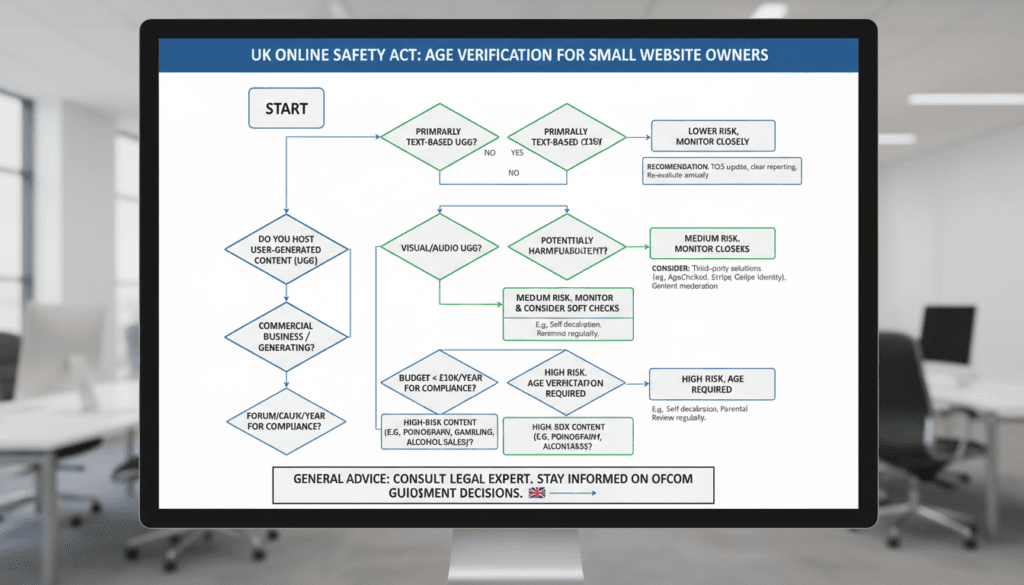
For a small UK-facing chat site, implementing age verification to meet the Online Safety Act is a significant undertaking. There are tools available – from AI face scanners to bank APIs – that can achieve compliance, but the realistic costs include direct vendor fees, integration effort, potential GDPR overhead, and the loss of users discouraged by the process.
In pure monetary terms, even a tiny site might spend a few thousand pounds a year on age-check services and still suffer reduced traffic. Larger sites can absorb such costs as part of doing business; smaller ones may not.
Ultimately, you face a tough choice:
- Invest in compliance and hope the remaining user base justifies the cost
- Modify your service to heavily moderate content, potentially reducing its appeal
- Geo-block UK users to avoid the requirements entirely
- Shut down if none of these options are viable
The spirit of the law is to protect children, a goal virtually everyone supports, but the implementation burden falls disproportionately on small online communities. As one analysis noted, treating every site like it has Big Tech resources means “all that will be left is Facebook” – an exaggeration, perhaps, but it underscores the risk that compliance costs will drive out independent sites.
While not outright impossible – solutions exist and some small sites will implement them – the Online Safety Act may fundamentally change the nature of “little” sites, forcing some to become more like gated clubs or to shut their doors to UK users entirely. The coming years will show whether a balance can be struck, perhaps through cheaper, privacy-preserving innovations, or support for small platforms to comply.
So What Are Small Website Owners Actually Supposed to Do?
Here’s the honest answer: nobody knows.
If you run a small chat site with UK users, you’re stuck. The law demands “highly effective age assurance” – costs outlined above are real, potentially thousands of pounds. But the big platforms haven’t implemented it. Random chat sites haven’t either. There’s been zero enforcement.
Practical steps you can take right now:
Audit and reduce obvious risks. Do you have completely unmoderated spaces where explicit content appears regularly? Add basic moderation, keyword filters, or report functions. It won’t satisfy the law, but it shows effort.
Document everything. If Ofcom comes knocking, prove you took this seriously. Keep records of moderation actions, filters, terms of service updates.
Watch the big players. When Discord, WhatsApp, or Telegram actually implement UK age verification, that’s your signal enforcement is real.
Know your risk level. Are you a visible target with a large userbase and media attention? Or a 200-person niche forum Ofcom’s never heard of? Your gamble is different.
Have an exit plan. Know what geo-blocking UK users looks like. Know what shutting down involves. At what point is the legal anxiety not worth it?
The brutal reality: This law assumes every website has a legal team and compliance budget. Small sites must choose between spending money they don’t have on compliance that may never be enforced, or ignoring a law that could theoretically destroy them.
Until regulators or courts provide clarity on enforcement, small website owners are flying blind. The goal of protecting children matters. The implementation is a disaster for anyone who isn’t Big Tech.