
-
 By Derek Duckworth
- January 7, 2026
- 0 Comments
- Blog
Chat Room Popularity Over Time: The Rise, Peak, and Decline of Online Chat Platforms
From the early days of IRC and Yahoo Chat to modern Discord communities. Explore the fascinating 30-year evolution of how we connect online.
- Remembering MSN nudges
- The golden era of Yahoo Chat
- IRC vs Modern Discord
Quick Poll: Which chat room did you use the most back in the day?
Live global votes tallied! (Total votes: 0)
From the early days of IRC to modern Discord communities, online chat rooms have undergone a remarkable evolution over the past three decades. What began as simple text-based exchanges has transformed into rich multimedia experiences that shape how we connect online. This comprehensive timeline explores the fascinating rise and fall of chat room popularity, revealing how each platform’s innovations influenced the next generation of online communication.
Whether you spent hours in Yahoo Chat rooms, customized your MSN Messenger status, or now manage multiple Discord servers, this data-driven history captures the platforms that defined each era of internet chat from 1995 to 2025.
Join our chat rooms here.
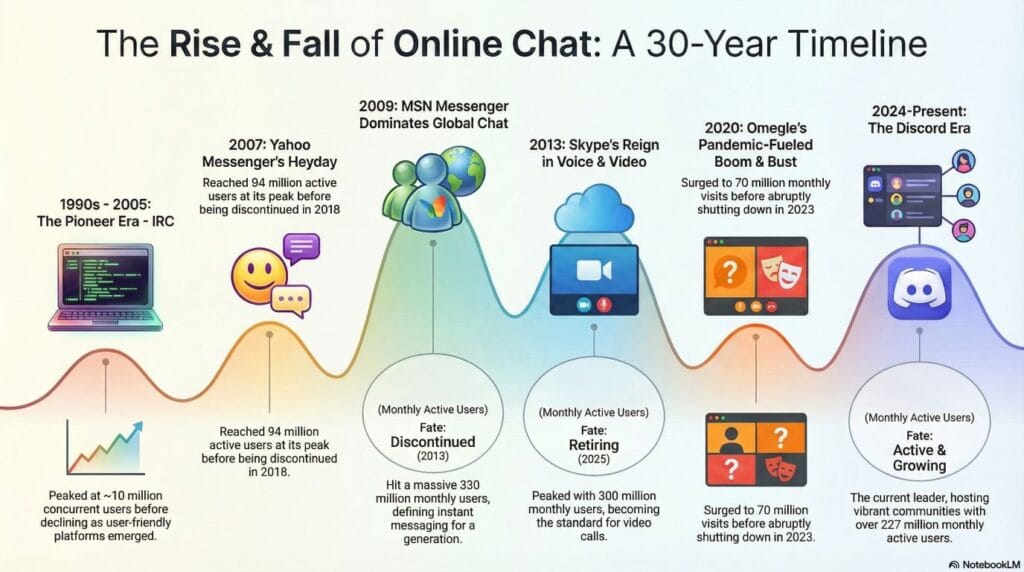
Timeline Overview: The Major Chat Eras
The history of online chat can be divided into distinct eras, each dominated by different platforms and technologies. From 1995-2002, IRC and early web chat laid the foundation for online communities. The period from 2000-2008 saw the rise of mainstream messengers like Yahoo, MSN, and AIM, bringing chat to millions of casual users. Between 2008-2014, Skype shifted the focus from text to voice and video communication. The 2009-2023 period was marked by Omegle’s random chat culture, while 2015 to the present has been defined by Discord’s community-focused approach.
More about the psychological effects of chat rooms on people here.
Each era brought innovations that shaped how we communicate online, with user numbers reflecting changing preferences and technological capabilities. Let’s explore each period in detail to understand how chat room popularity evolved over time.
Related Guides
Who Uses Chat Rooms in 2026? Age, Gender and Time Spent
https://www.worldofchat.co.uk/chat-room-users-2026/
Do Chat Rooms Make Us More Honest or Just More Lonely?
https://www.worldofchat.co.uk/chat-rooms-make-us-more-lonely/
Being Ignored Online Hurts More Than You Think
https://www.worldofchat.co.uk/being-ignored-online-hurts/
How We Talk Online: What Your Chat Habits Reveal About You
https://www.worldofchat.co.uk/how-we-talk-online/
How to Use a Chat Room (Simple Guide for Beginners)
https://www.worldofchat.co.uk/how-to-use-a-chat-room-comprehensive-guide/
The Shifting Demographics of Chat Room Users
As chat platforms evolved over the last thirty years, the people using them changed just as drastically.
In the early 1990s, the demographic was almost exclusively male tech-enthusiasts, university students, and IT professionals who had the technical know-how to navigate command-line interfaces. However, the launch of Yahoo Chat and MSN Messenger in the early 2000s completely democratized online communication. Suddenly, the primary demographic shifted to mainstream teenagers and young adults. Chat rooms became the digital equivalent of the local mall, achieving a nearly even 50/50 gender split as millions logged on after school.
Today, chat room demographics have splintered into highly specific user bases depending on the type of chat room they are using:
- The Gamers & Gen Z (Discord & Twitch): Young adults (16-24) dominate the modern recreational chat space. On platforms like Twitch, the concept of the chat room has evolved into a spectator sport, where millions of users react live to streaming video content simultaneously.
- The Professionals (Slack & Microsoft Teams): Chat rooms are no longer just for after-hours socializing. The millennial and older workforce (25-54) now spend an average of 8 hours a day in professional, corporate chat ecosystems like Slack, fundamentally changing how global businesses operate.
(For a complete statistical breakdown of exactly who is chatting online today, read our full report on Who Uses Chat Rooms in 2026? Age, Gender and Time Spent).
The Pre-IRC Era: Where It All Began (1970s – 1980s)
While many consider the 1990s the birth of online chat, the true history of chat rooms began decades earlier on university mainframes.
In 1973, researchers at the University of Illinois created Talkomatic on the PLATO computer system. Widely recognized as the world’s first chat room, Talkomatic allowed up to five people to type messages simultaneously on their terminals. Unlike modern chat where you hit “send” to broadcast a completed message, Talkomatic updated character-by-character in real-time, meaning users actively watched each other type and erase mistakes live.
By 1980, the concept finally reached the public with the launch of the CompuServe CB Simulator. Inspired by the massive popularity of physical Citizen’s Band (CB) radios at the time, CompuServe allowed civilian computer users to connect via early dial-up modems and chat across 40 different “channels.” As the first commercial chat platform, it introduced the world to the idea of logging into a digital room to socialize with total strangers—long before the World Wide Web even existed. These early text-based experiments laid the vital groundwork for the global phenomenon that was about to follow.
The IRC Peak (1990s – Early 2000s)
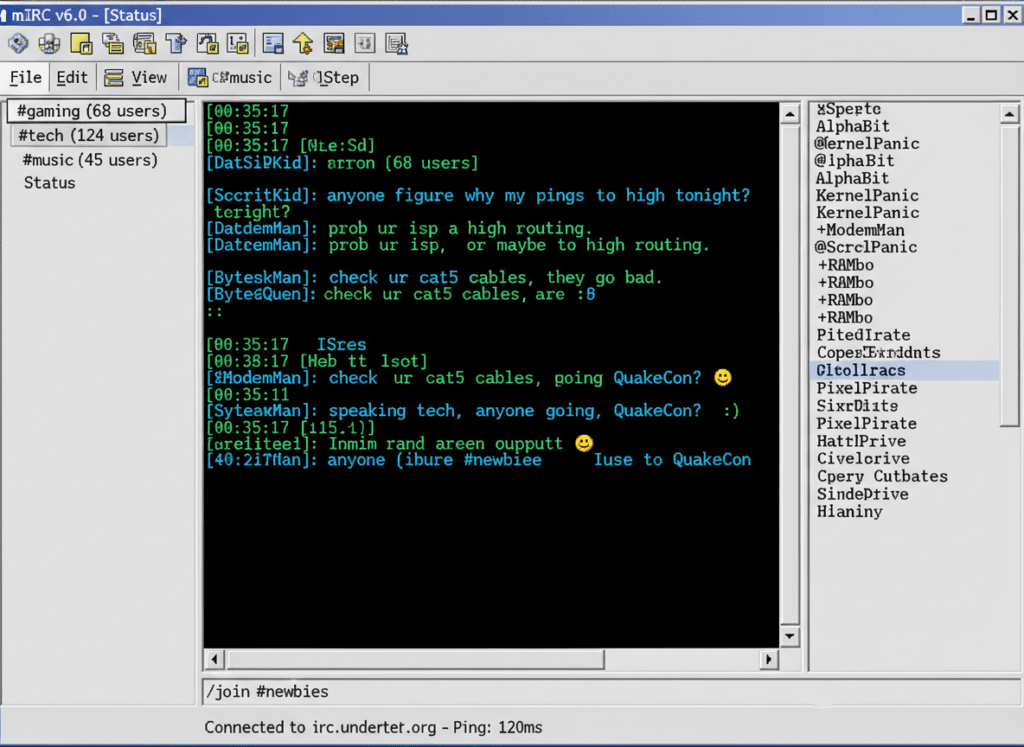
Internet Relay Chat: The Foundation of Online Chat
Internet Relay Chat (IRC) emerged in 1988 as one of the first real-time chat systems, reaching its peak popularity in the early 2000s with approximately 10 million concurrent users across networks like EFnet, Undernet, and DALnet. IRC pioneered many concepts we take for granted today: channels (rooms), operators (moderators), and private messaging.
What made IRC special was its decentralized nature – no single company controlled it. Users could join existing networks or create their own, fostering diverse communities around specific interests. The platform thrived in tech-savvy circles, becoming essential for open-source projects, gaming communities, and early internet culture.
| IRC Network | Peak Users (circa 2004) | Notable Communities |
| EFnet | ~120,000 | Gaming, hacking, general chat |
| Undernet | ~250,000 | Role-playing, international communities |
| DALnet | ~140,000 | File sharing, tech support |
| QuakeNet | ~200,000 | Gaming, especially Quake and Counter-Strike |
Why IRC Declined
Despite its popularity among tech enthusiasts, IRC faced significant challenges that limited its mainstream appeal. The command-line interface presented a steep learning curve for casual users. As graphical instant messengers like AIM and MSN emerged with user-friendly interfaces, IRC’s growth stalled. The lack of built-in multimedia support became increasingly problematic in an era where sharing images and files became essential to online communication.
Today, IRC remains active but serves a niche audience, primarily in tech communities and open-source projects. Its influence lives on in modern platforms like Discord, which adopted many IRC concepts while adding user-friendly interfaces and multimedia capabilities.
Yahoo Chat & Messenger Era (Early–Mid 2000s)
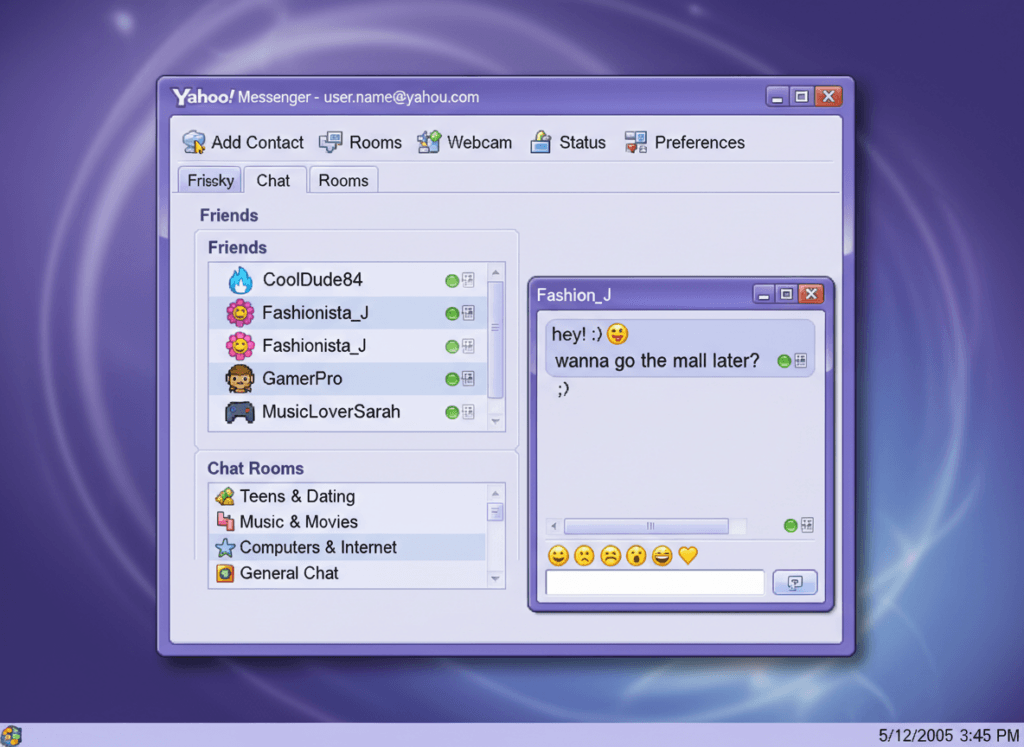
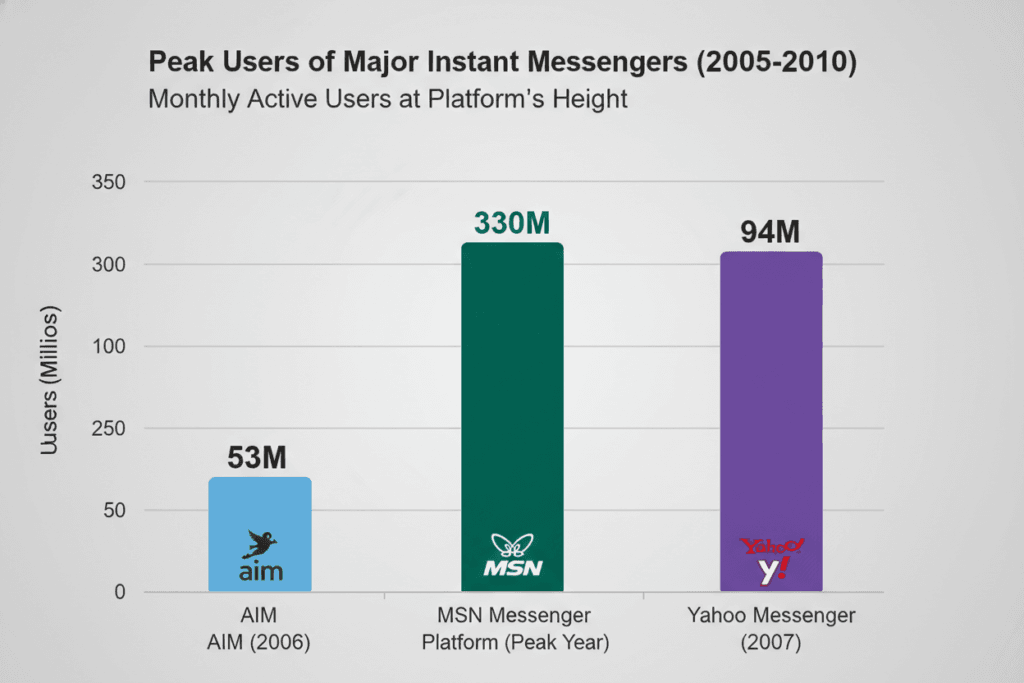
Yahoo Chat Rooms became cultural hubs in the early 2000s, offering themed rooms where millions gathered to discuss everything from music and sports to regional interests. Unlike IRC’s technical barrier to entry, Yahoo’s web-based interface made chat accessible to mainstream internet users. At its peak around 2007, Yahoo Messenger boasted approximately 94 million users worldwide.
Feature Innovations That Drove Popularity
Yahoo Messenger introduced several features that revolutionized online chat, making communication more personal and expressive. Customizable avatars allowed users to create visual identities. Integrated webcam support transformed text-only conversations into face-to-face interactions. Voice chat capabilities provided an alternative to typing, while custom status messages became a form of self-expression.
These innovations helped Yahoo Messenger become a daily communication tool for millions, particularly in regions like Southeast Asia and the Middle East, where it remained dominant even as other platforms gained traction in North America and Europe.
The Decline of Yahoo Chat
Several factors contributed to Yahoo Chat’s eventual downfall. Spam and inappropriate content became increasingly difficult to moderate as user numbers grew. The rise of social networks like Facebook offered integrated chat alongside other social features, making standalone chat applications less necessary. Mobile messaging apps provided better experiences on smartphones as internet usage shifted away from desktop computers.
Yahoo began shutting down various chat features in 2012, and by 2018, Yahoo Messenger was completely discontinued. The once-thriving chat ecosystem that connected millions had been rendered obsolete by evolving technology and changing user preferences.
MSN Messenger: The King of IM
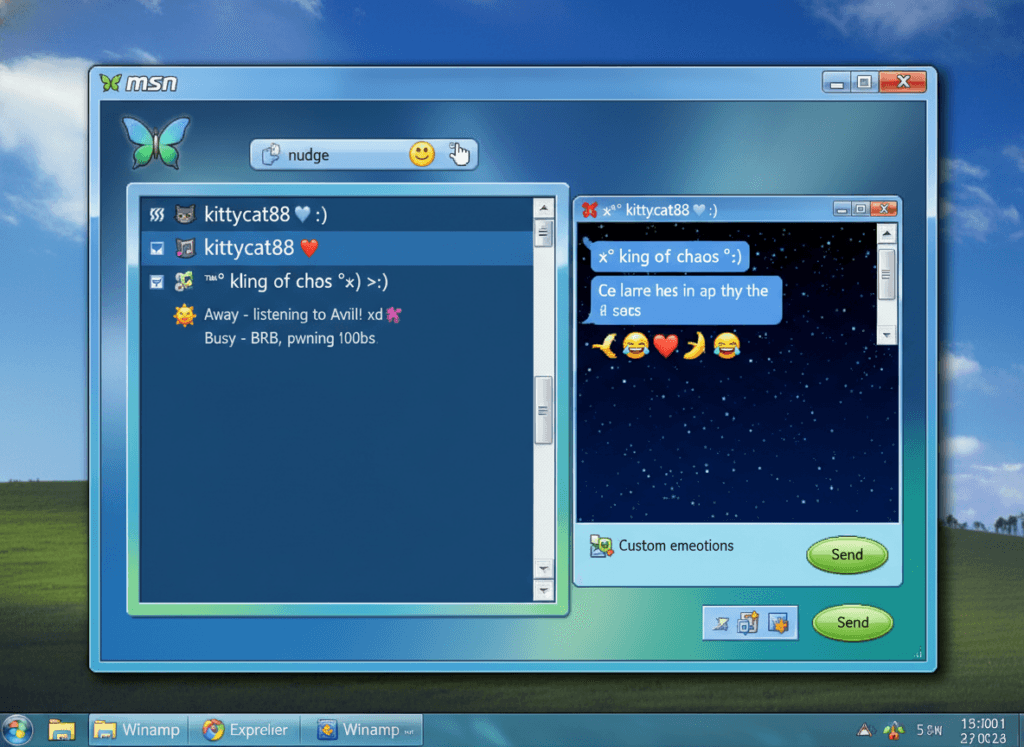
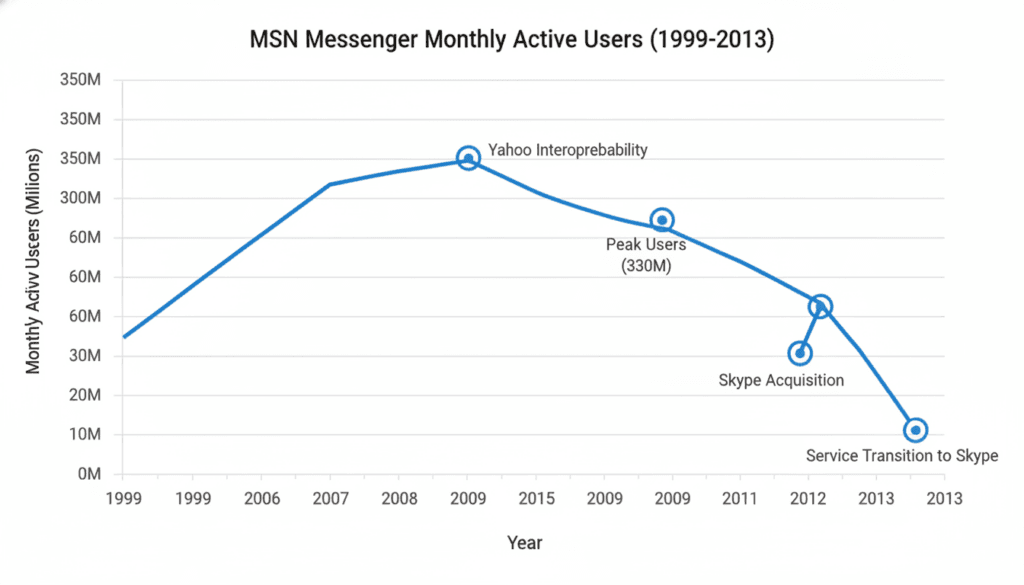
MSN Messenger (later Windows Live Messenger) dominated the instant messaging landscape from the early 2000s through 2010. Launched in 1999, it leveraged Microsoft’s Windows operating system to achieve unprecedented global reach. By 2009, it had reached an astonishing 330 million monthly active users, making it the most widely used chat platform in history at that time.
Cultural Impact and Innovations
MSN Messenger transcended its role as a communication tool to become a cultural phenomenon. The platform introduced features that became part of everyday language and behavior:
- Nudges – The attention-grabbing shake feature that became both loved and hated
- Custom display names – Often used to share song lyrics, relationship status, or cryptic messages
- Winks and emoticons – Expanding text-based communication with visual expressions
- Games and activities – Allowing friends to play together while chatting
The platform’s interoperability with Yahoo Messenger (introduced in 2006) expanded its reach further, allowing users to chat across platforms. This period represented the height of chat room popularity as measured by total active users.
The End of an Era
Microsoft’s acquisition of Skype in 2011 signaled the beginning of the end for MSN Messenger. Users were gradually transitioned to Skype between 2013 and 2014, with the final shutdown occurring in October 2014 (China’s service continued until 2015). The closure sparked widespread nostalgia, with many users logging in one last time to say goodbye to friends and an era of internet communication.
Google Trends data shows significant spikes in searches for “MSN Messenger” around shutdown announcements and again during nostalgic retrospectives, demonstrating the platform’s lasting cultural impact even years after its discontinuation.
Skype Takes Over (Late 2000s – Early 2010s)

As MSN Messenger and other text-based platforms declined, Skype emerged as the dominant communication tool of the late 2000s and early 2010s. Founded in 2003 and acquired by Microsoft in 2011 for $8.5 billion, Skype represented a fundamental shift in online communication – from text-centric chat to voice and video interaction.
The Voice and Video Revolution
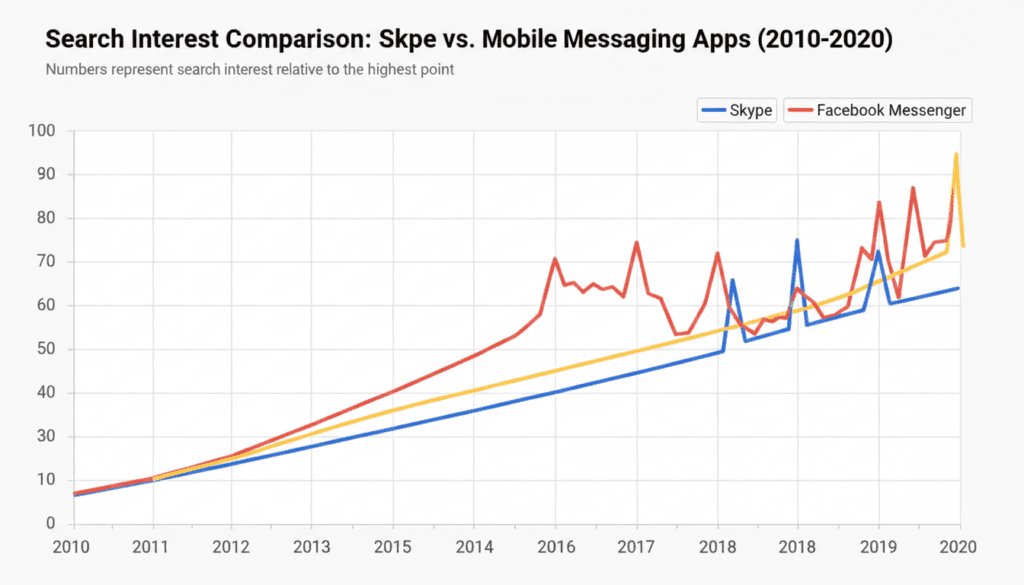
Skype’s primary innovation was making voice and video calling accessible and free between users. While earlier platforms had experimented with these features, Skype made them central to the experience. By 2013, Skype reached approximately 300 million monthly active users and accounted for an estimated 40% of all international call minutes globally.
The platform bridged personal and professional communication, becoming essential for both families staying in touch across distances and businesses conducting remote meetings. This dual-purpose utility helped Skype maintain relevance even as specialized competitors emerged.
Decline Factors
Despite its massive success, Skype began losing ground in the mid-2010s due to several factors. Mobile-first messaging apps like WhatsApp and Facebook Messenger offered better experiences on smartphones, where internet usage was increasingly concentrated. Specialized business tools like Zoom and Microsoft Teams provided features tailored to professional use cases.
Microsoft’s announcement that Skype will be retired in 2025 marks the end of another significant chapter in chat history. Like its predecessors, Skype is being replaced by platforms that better address evolving user needs and technological capabilities.
Omegle: Viral Growth & Sudden Collapse
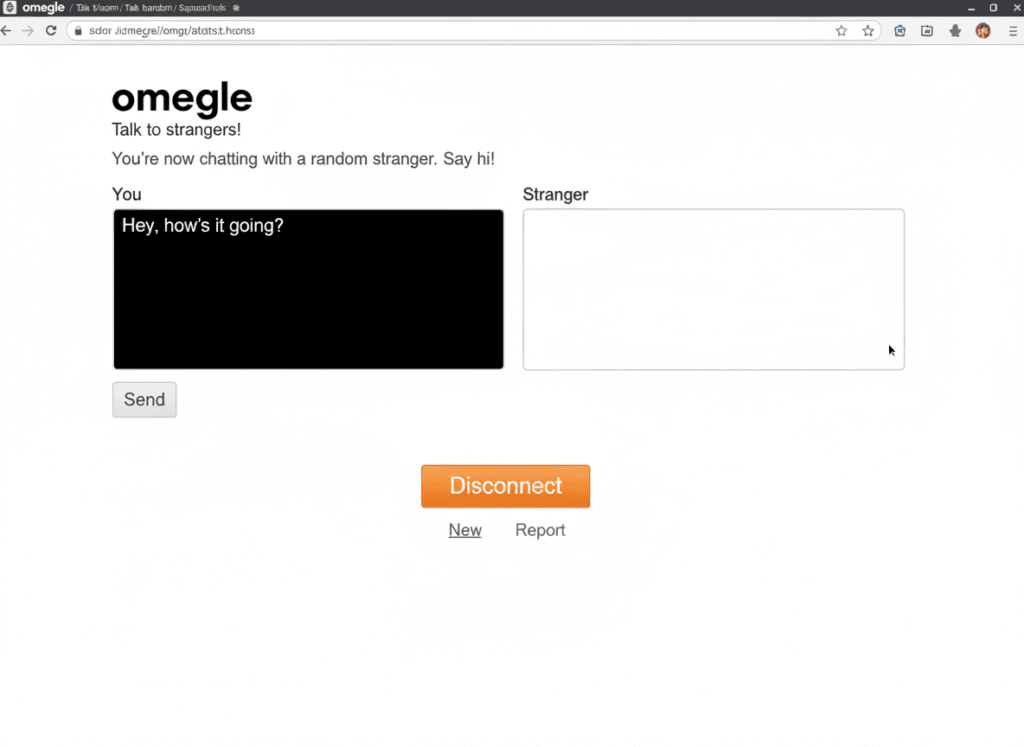
While established platforms evolved toward persistent identities and communities, Omegle took online chat in the opposite direction when it launched in 2009. Created by an 18-year-old developer, the platform paired random strangers for anonymous conversations with no registration required. This radical simplicity created an entirely different chat experience focused on novelty and spontaneity rather than relationship building.
Pandemic-Driven Explosion
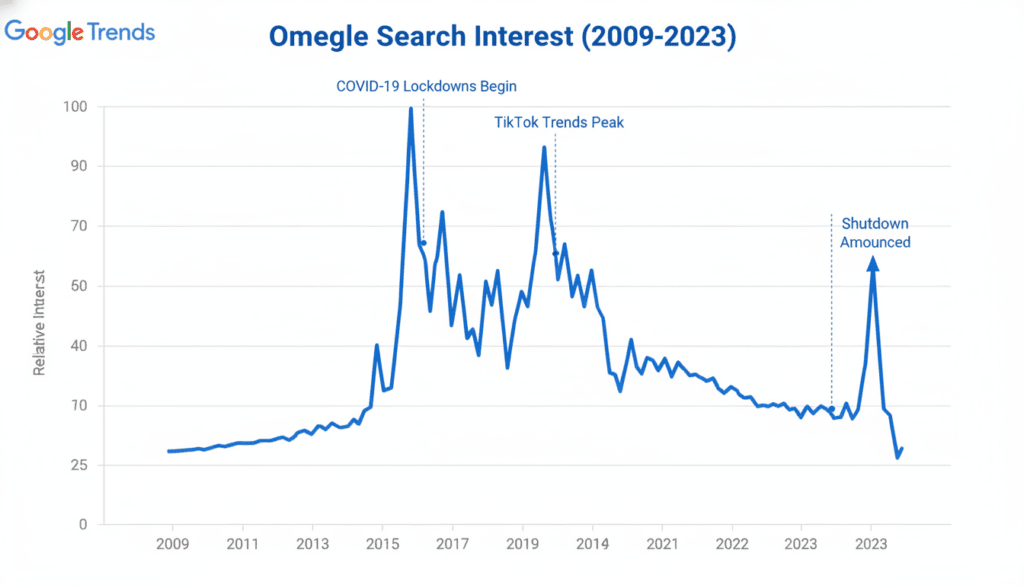
Omegle experienced moderate growth for its first decade but exploded in popularity during the COVID-19 pandemic. As lockdowns limited in-person social interactions, many turned to Omegle for spontaneous human connection. TikTok trends featuring Omegle interactions further fueled growth, with monthly visits peaking at approximately 70 million in early 2021.
Safety Concerns and Shutdown
Omegle’s anonymous nature created significant moderation challenges. Despite implementing an age verification system and monitored video chat, the platform struggled with inappropriate content and predatory behavior. Legal challenges mounted, culminating in Omegle’s abrupt shutdown in November 2023.
In the shutdown announcement, founder Leif K-Brooks cited the emotional and financial toll of combating misuse of the platform. Omegle’s rise and fall demonstrates how chat platforms must balance openness with safety, particularly when serving younger users.
The Discord Era (2015–Present)
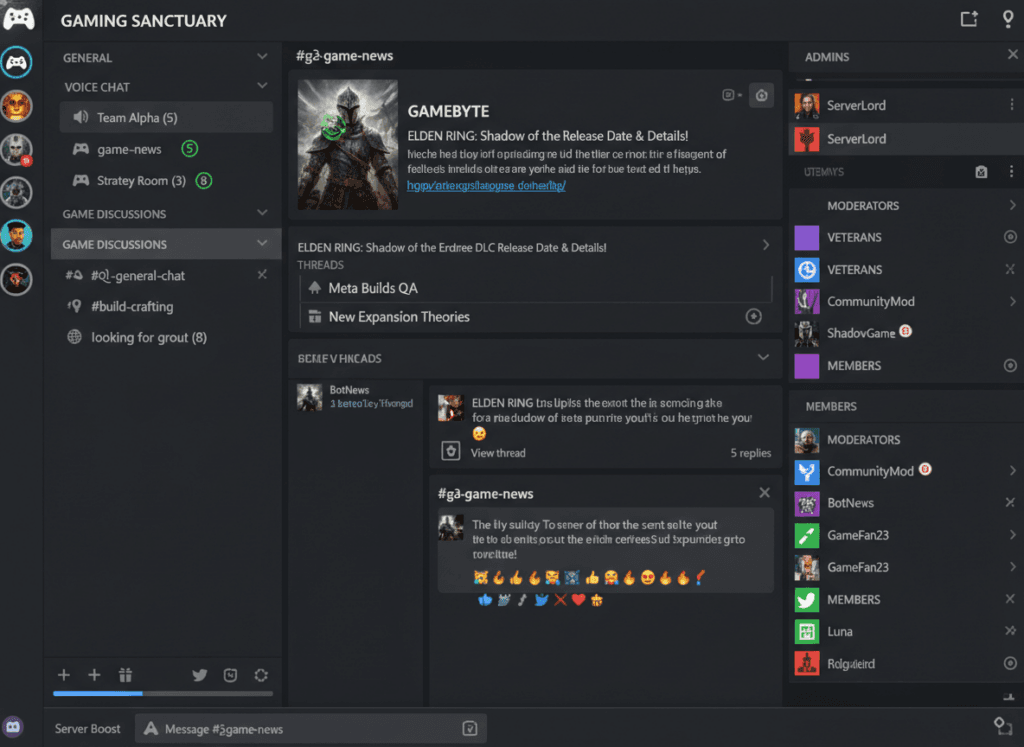
Discord launched in 2015 as a communication platform for gamers but has since evolved into the dominant community chat platform of the 2020s. By combining IRC’s community-focused structure with modern features and usability, Discord effectively reimagined chat rooms for contemporary internet users. As of 2024, the platform boasts approximately 227 million monthly active users and continues to grow.
Why Discord Succeeded Where Others Failed
Discord’s success can be attributed to several key factors that addressed the limitations of previous platforms:
Community Ownership
Discord’s server model allows users to create and fully control their own communities, complete with customizable roles, permissions, and moderation tools. This empowers users to build spaces tailored to specific interests or social groups.
Persistent Identity
Unlike anonymous chat platforms, Discord users maintain consistent identities across servers, building reputation and relationships over time while still controlling their privacy through selective server membership.
Multimedia Integration
Voice channels, video sharing, screen sharing, and rich media embeds create a comprehensive communication experience that adapts to different needs and contexts.
Free Core Experience
Discord’s core features remain free, with monetization through optional Nitro subscriptions for enhanced features rather than advertising or essential functionality paywalls.

Discord represents the culmination of chat room evolution – combining the community focus of IRC, the multimedia capabilities pioneered by platforms like Skype, and the accessibility that made mainstream messengers popular. Its continued growth suggests that the future of online chat lies in persistent, identity-based communities rather than anonymous or ephemeral interactions.
The Modern Ecosystem: Workspaces and Livestreams
While Discord currently dominates the community and gaming space, the fundamental concept of the chat room has recently branched out to conquer two other massive modern ecosystems: the corporate workspace and live entertainment.
The Corporate Chat Room (Slack & Microsoft Teams) In the 2010s, platforms like Slack and later Microsoft Teams took the original concept of IRC channels and repackaged them for the modern workplace. Instead of casual socializing, these chat rooms are built for real-time project management and office communication. By organizing conversations into specific “#channels” and integrating with countless productivity apps, Slack essentially killed the internal company email. It proved that the classic chat room format is still the most efficient way for global teams to collaborate.
The Spectator Chat Room (Twitch) On the opposite end of the spectrum, live-streaming platforms like Twitch evolved the chat room into a spectator sport. On Twitch, a massive, fast-moving chat room is permanently anchored next to live video broadcasts. For many users, the rapid-fire scrolling text, inside jokes, and shared reactions of the chat room are actually more entertaining than the video content itself. This represents a massive shift in chat room popularity: the chat room is no longer just a private place to talk—it has become a public form of interactive entertainment.
Google Trends: Popularity Shifts Over Time
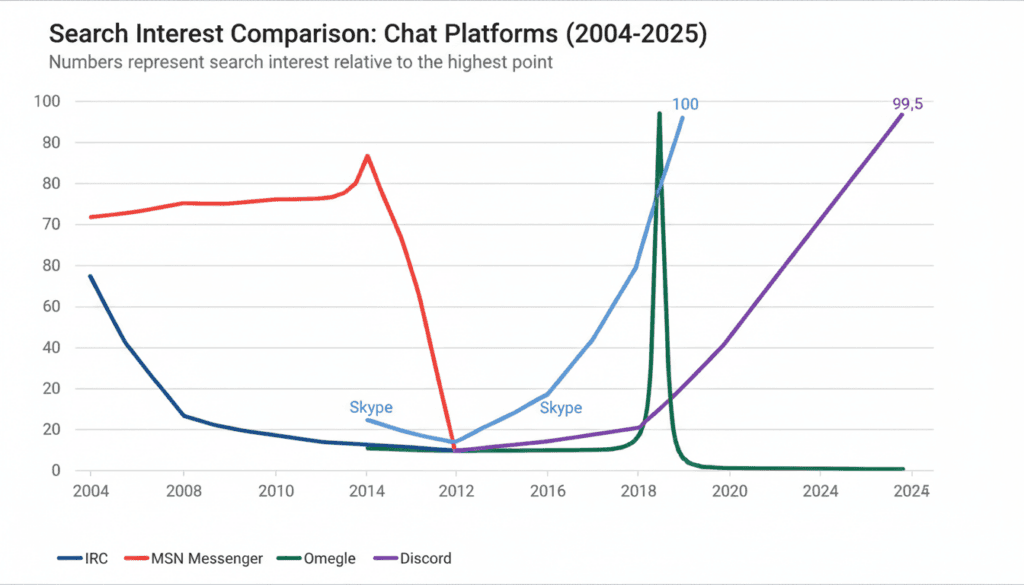
Google Trends data provides a fascinating visualization of how public interest in chat platforms has shifted over time. Search interest closely mirrors actual usage patterns and cultural relevance, showing clear transitions between dominant platforms.
Key Observations from Search Trends
Several patterns emerge when analyzing search interest data for major chat platforms from 2004 to 2025:
- Legacy Platform Decline – IRC, MSN Messenger, and Yahoo Chat all show steadily declining search interest since 2004, with occasional nostalgia-driven spikes around shutdown announcements
- Skype’s Rise and Fall – Skype shows increasing search interest from 2004-2013, followed by gradual decline as mobile messaging apps gained popularity
- Omegle’s Pandemic Spike – Omegle demonstrates relatively flat interest until an enormous spike during 2020-2021, followed by decline and a final spike at shutdown
- Discord’s Steady Growth – Discord shows consistent growth since 2015, accelerating during the pandemic and continuing upward while other platforms plateau or decline
These trends illustrate how chat platforms follow technological adoption curves, with interest growing as they gain users, peaking during their dominant period, and declining as newer alternatives emerge. The data also reveals how external events like the COVID-19 pandemic can dramatically impact platform usage and search interest.
Peak Popularity Comparison Table
| Platform | Launch | Peak Year | Peak Metric | Status |
| IRC | 1988 | 2004–05 | ~10M concurrent | Niche |
| Yahoo Messenger | 1998 | 2007 | ~94M users | Shut down |
| MSN Messenger | 1999 | 2009 | 330M MAU | Shut down |
| Skype | 2003 | 2013 | ~300M MAU | Retiring 2025 |
| Omegle | 2009 | 2020 | ~70M monthly visits | Shut down |
| Discord | 2015 | 2024 | ~227M MAU | Growing |
This comparison highlights how each platform reached different scales of popularity during their respective peak periods. MSN Messenger achieved the highest overall user count, while Discord continues to grow and may eventually surpass these historical peaks. The varying metrics (concurrent users vs. monthly active users) reflect different measurement approaches across platforms and eras.
Conclusion: Chat Never Died — It Evolved
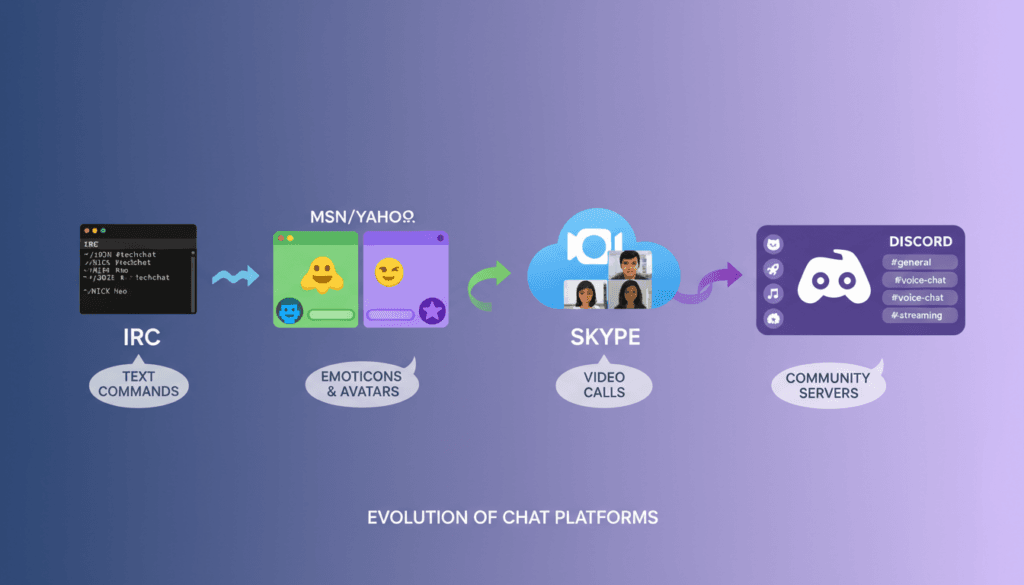
The history of chat room popularity over time reveals not a story of decline, but one of continuous evolution and adaptation. Each generation of chat platforms has built upon the innovations of its predecessors while addressing their limitations. What appears as the “death” of platforms like MSN Messenger or Yahoo Chat is better understood as transformation – the core human need for connection remains, but how we satisfy that need changes with technology and social trends.
Today’s dominant platform, Discord, represents a synthesis of what worked best in previous generations: IRC’s community structure, instant messengers’ accessibility, Skype’s multimedia capabilities, and modern design sensibilities. As technology continues to advance, we can expect chat platforms to further evolve, potentially incorporating virtual reality, augmented reality, or artificial intelligence to create even more immersive and meaningful connection experiences.
The story of chat rooms is ultimately a human story – about our fundamental desire to connect with others across distance and time. While platforms rise and fall, this basic need ensures that online chat, in whatever form it takes, will remain an essential part of our digital lives.
Explore Today's Chat Communities
Discover how modern platforms have evolved the chat experience. Join thriving communities built around your interests and connect with like-minded people worldwide.
If you are looking for more information about the chat rooms popularity over time, there is more analysis here.
Sources & Methodology
This article synthesizes data from multiple sources to create a comprehensive overview of chat room popularity over time. User numbers and dates are compiled from:
- Platform Documentation – Official announcements and historical records from the companies behind these platforms
- Google Trends Data – Search interest patterns that correlate with platform popularity and cultural relevance
- Tech News Archives – Contemporary reporting on user numbers, feature launches, and platform shutdowns
- Industry Analyst Reports – Third-party estimates of user numbers and market share
Exact user numbers vary between sources due to different measurement methodologies. Monthly Active Users (MAU) counts active accounts over a 30-day period, while concurrent users measures simultaneous online users at a given moment. Where ranges exist in reported figures, we’ve used conservative estimates and noted approximations.
The visual representations suggested throughout this article are based on available data and designed to illustrate key trends in chat room popularity over time rather than precise measurements.